
That sudden plunge into darkness isn’t just an inconvenience; it’s your home’s most important safety feature working exactly as it should. When your safety switch tripped, it did its job by instantly cutting the power because it detected a dangerous current leakage, a fault that could have led to a serious electric shock.
This is a world away from a circuit breaker tripping because you ran the kettle and the toaster at the same time. Think of it this way: a safety switch is a personal bodyguard for you and your family, while a circuit breaker protects your appliances and wiring. The technical name for a safety switch is a Residual Current Device (RCD), and its one and only mission is to watch the flow of electricity, shutting it all down the moment it senses even the tiniest imbalance.
We have a full guide that goes deeper into what a residual current device is, but the main thing to know is that these imbalances (or ‘earth leakage faults’) usually pop up for a few common reasons.
- A faulty or ageing appliance: This is a classic. Electricity starts “leaking” to the metal casing of an old fridge or a dodgy toaster.
- Moisture ingress: Water getting into an outdoor power point is a very common problem, especially during Brisbane’s humid summers and storm season.
- Damaged wiring: This could be anything from a rat chewing on a cable inside a wall to accidentally drilling through a wire during some weekend DIY.
Unlike a simple overload, a tripped safety switch points to a genuine electrical fault that needs investigating. These devices are incredibly sensitive and act lightning-fast. In Australia, an RCD is built to trip in as little as 0.03 seconds when it detects a leakage of just 30 milliamps. That life-saving speed is precisely why they’re mandated under Australian Standards (AS/NZS 3000).
A tripped safety switch is a clear warning from your electrical system. It’s telling you there’s a potential risk of electric shock or fire somewhere in that circuit. Never ignore it.
Worryingly, even though RCDs have been common for decades, it’s estimated that around 40% of Australian households still don’t have adequate safety switch protection, leaving them exposed to preventable dangers. This is a massive concern for us, especially in the older properties we see across Brisbane, Ipswich, and the Redlands, many of which may not meet the current compliance standards set by the Electrical Safety Office (ESO).
How to Safely Find a Faulty Appliance
So, your safety switch has tripped, and the power’s out. It’s a common scenario, and more often than not, it’s caused by a single faulty appliance somewhere in your home. Before you even think about calling a licensed electrician, there’s a simple and safe diagnostic process you can run through yourself.
Let’s be clear: this is not about doing any electrical work. That’s illegal and incredibly dangerous for anyone without a licence in Queensland. This is purely a process of elimination to find the culprit. Following these steps can help you figure out if it’s a simple fix—like a dodgy kettle—or a deeper problem that needs our professional help.
The Unplug and Isolate Method
When that safety switch flicks off, your first instinct might be to just flip it back on. Don’t. The first thing you need to do is go to your switchboard. Find the safety switch that’s tripped, and then turn off all the individual circuit breakers connected to it. You’ll usually see them grouped together right next to the safety switch (often labelled RCD).
Now for the legwork. You need to go through your house and unplug absolutely everything on those circuits. We mean everything. The fridge, the microwave, the TV, every phone charger, the lot. Don’t just switch them off at the wall—physically pull the plug out.
This flowchart is a great way to visualise what’s happening. A safety switch trip is different from a circuit breaker trip.
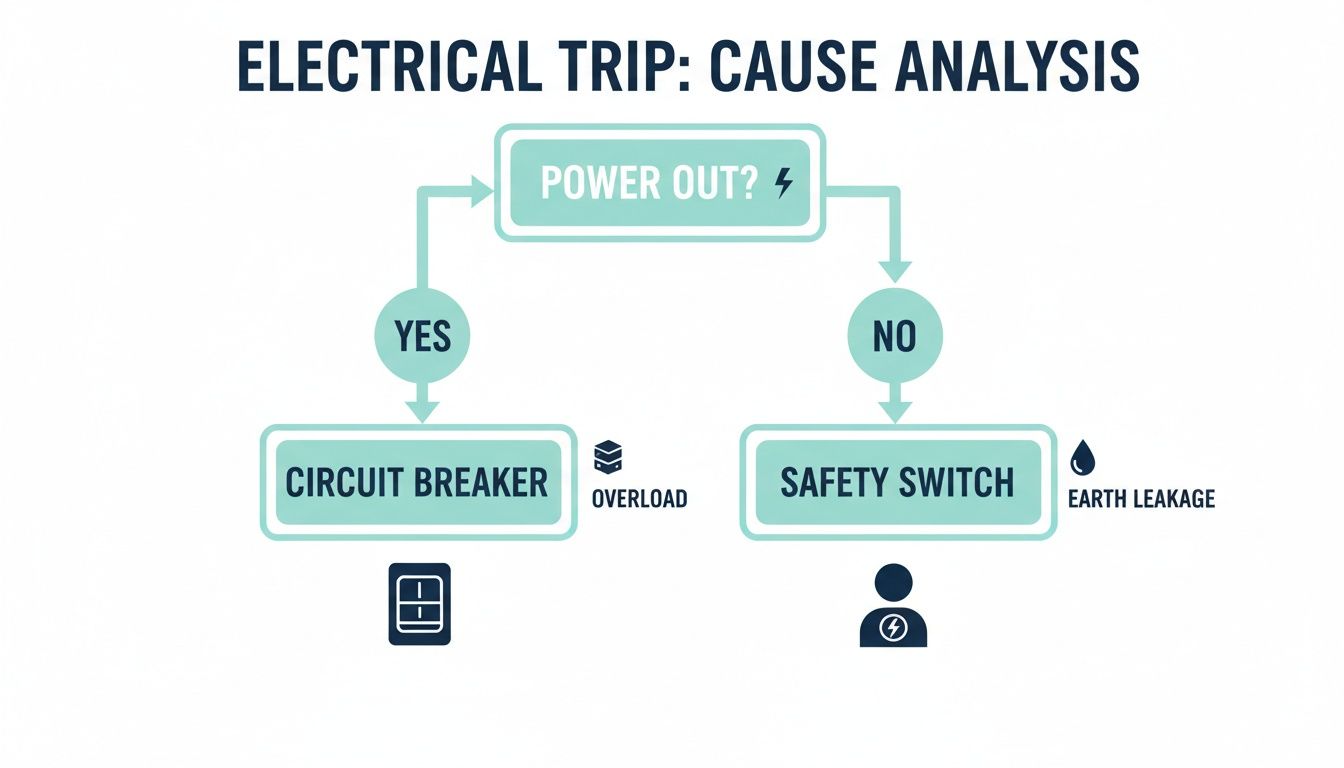
The key takeaway here is that a safety switch trip signals an earth leakage fault—a serious shock risk. A circuit breaker, on the other hand, usually just means you’ve plugged too many things in at once.
Restoring Power and Pinpointing the Problem
Once every single appliance is unplugged, head back to your switchboard. Now, you can try resetting the safety switch by pushing it back to the ‘ON’ position. If it stays on, fantastic! That’s a strong sign the problem is with one of the appliances you just unplugged, not your home’s wiring.
This is where the methodical part begins. Go back and start plugging your appliances in one by one. Plug one in, switch it on, and wait a moment.
Important Safety Note: Take your time. Don’t rush this. Plug in the fridge, wait. Nothing happens? Good. Move on to the toaster. The very moment you plug in an appliance and the safety switch trips again, you’ve found your culprit.
Let’s say you’re in your kitchen in Camp Hill. You plug in the fridge, then the microwave, and everything’s fine. But as soon as you plug in the dishwasher and hit the power button, click—the power goes out again. That’s it. You’ve almost certainly found the problem.
That faulty appliance needs to be left unplugged. You’ll need to get it repaired by a qualified technician or, more likely, replace it. This little process not only keeps you safe but can save you the cost and hassle of an emergency call-out fee. For more insights on common issues we see, check out our guide on the most common electrical problems in Brisbane homes.
Common Reasons Your Safety Switch Keeps Tripping
If your safety switch has started tripping on a regular basis, it’s a sure sign of a persistent electrical issue that you really can’t afford to ignore. We call this ‘nuisance tripping’ in the trade, and it almost always has a root cause. Figuring out what to look for is the first step in knowing when it’s time to call in a licensed electrician.
A one-off trip might just be a small glitch with an appliance, but when it keeps happening, something more stubborn is at play.
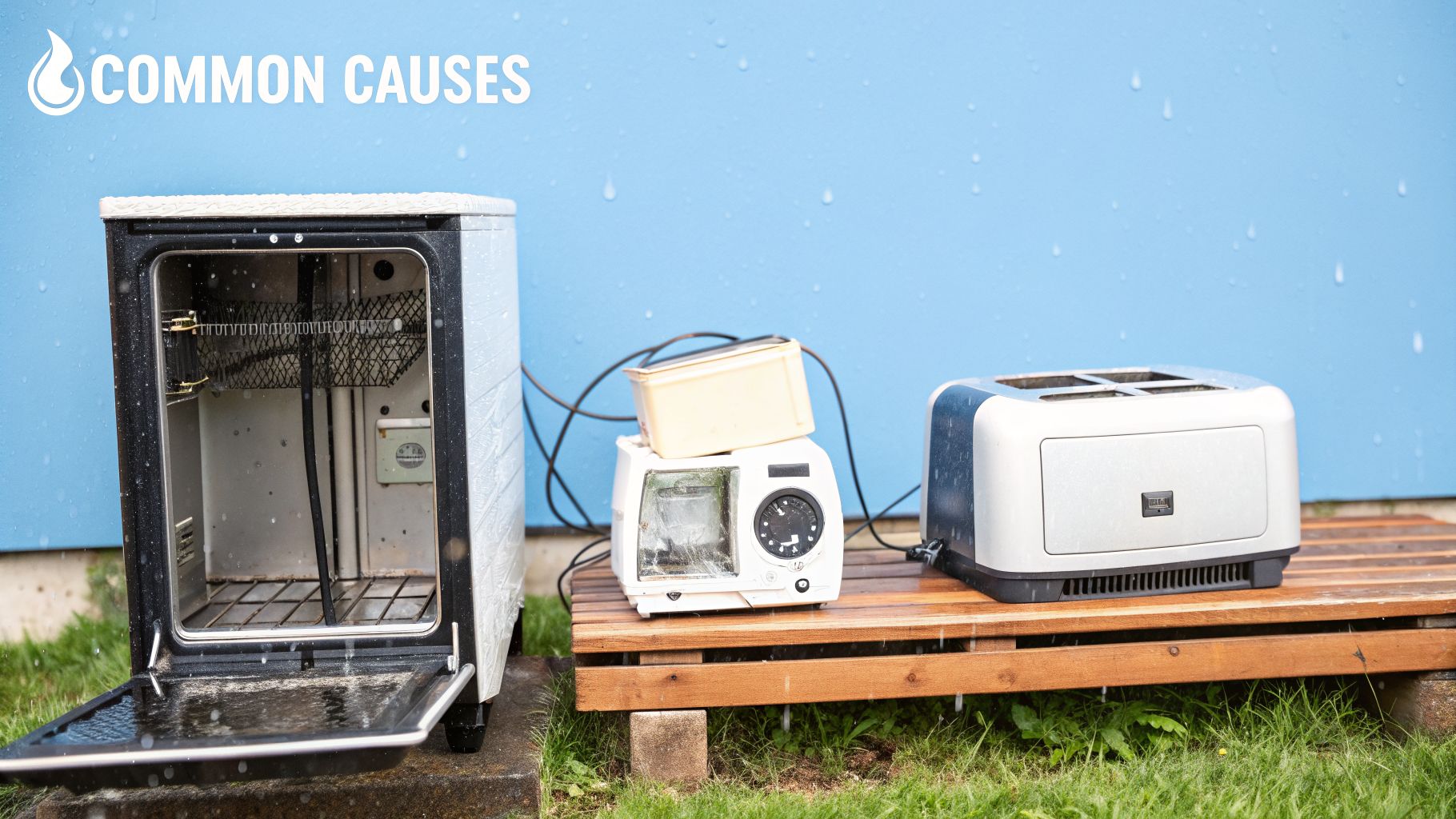
Moisture and Water Ingress
Here in South East Queensland, moisture is one of the biggest culprits behind a tripped safety switch. Brisbane’s subtropical climate brings high humidity year-round, and the torrential downpours we get during storm season can be brutal on any outdoor electrical systems.
Consider this scenario: you’ve got a garden light or an external power point that isn’t perfectly sealed. All it takes is a tiny bit of water to seep in, creating a path for electricity to leak to the earth. That’s an instant trip for your RCD. It’s not just an outdoor problem, either—we’ve traced tripping issues back to small, undetected leaks from dishwashers, fridges, or hot water systems. A slow drip behind a kitchen cabinet in a Carindale home, for instance, could be the sneaky source of your power woes.
Ageing and Faulty Appliances
Another incredibly common reason for a tripping safety switch is a good old-fashioned faulty appliance. Over the years, the internal wiring and components in devices like your oven, washing machine, kettle, or toaster will naturally degrade. The insulation can become brittle and crack, allowing a tiny amount of current to leak to the appliance’s metal casing.
This small earth leakage might not be enough to trip the switch straight away. The problem is, it can build up over time or even combine with tiny leakages from other appliances. Once the total leakage hits the 30-milliamp threshold, your RCD will do its job and cut the power. This is a dead giveaway that the appliance is no longer safe to use.
Sometimes, the fault only shows up when an appliance heats up or starts a particular cycle, which makes it a real headache to identify without that methodical process we walked through earlier.
Pest and Environmental Damage
It might sound strange, but pests cause a surprising number of electrical faults across Brisbane, from leafy suburbs like Camp Hill to the bigger acreage properties in Moreton Bay. Geckos and small rodents are notorious for crawling into warm, dry switchboards or behind appliances for shelter. If they happen to crawl across two live terminals, they can create a short circuit that trips your safety switch in a flash.
It’s not just critters, either. In coastal areas like Redcliffe and the Redlands, the salty air significantly speeds up corrosion on outdoor fittings. This can compromise their integrity and lead to faults down the track. Knowing the potential causes of electrical faults is a key part of homeownership, which you can read more about in our article on electrical fault prevention for Brisbane homes.
When a Tripped Switch Signals a Deeper Problem
So, you’ve done the hard work. You’ve gone through our isolation test, unplugged absolutely everything, and the safety switch still won’t reset. Or maybe it flicks off the very instant you try to turn it back on. This is a major red flag. It’s your electrical system’s way of shouting that the problem isn’t a faulty toaster. It’s a serious fault buried somewhere within your home’s fixed wiring.
When this happens, the risk of electric shock or fire goes up dramatically. This isn’t a problem you can fix by trying again and again. The moment a safety switch tripped and refuses to reset with everything unplugged, you need to treat it as an emergency. Your next and only step should be to go straight to your switchboard, turn off the main switch to kill all power, and call a licensed electrician immediately.
What Could Be Happening in Your Walls
A fault in your fixed wiring can come from all sorts of hidden dangers. Here in South East Queensland, we come across these issues all the time, and they all require professional tools and expertise to find and fix safely. Common causes we see include deteriorated wiring insulation in the hot roof cavities of a classic Queenslander, accidental damage from a screw, or water ingress from a storm.
Let’s say a screw for a new picture hook has pierced a cable inside a wall, or a possum has chewed through wiring in a sub-floor. In either case, the protective insulation around the cable is compromised, allowing the live conductor inside to touch other wires or earthed metal surfaces. A slow leak from a recent storm tracking along roof beams and into your ceiling wiring is another lethal mix that will instantly and correctly trip your safety switch.
This is a critical warning that you should never, ever ignore. Attempting to force the switch back on or fiddle with the wiring yourself is not only illegal under Queensland’s Electrical Safety Act 2002 but is also potentially life-threatening.
The statistics are a stark reminder of the dangers. Data consistently shows that electrical faults are a leading cause of house fires, and most residential electrocution fatalities are due to issues like faulty wiring. It’s crucial to understand why you should never neglect minor electrical problems. Only a licensed professional has the training, equipment, and legal authority to trace and rectify these faults in compliance with the AS/NZS 3000 Wiring Rules, ensuring your home is safe once more.
Proactive Electrical Maintenance to Prevent Tripping
Let’s be honest, the best way to deal with a tripped safety switch is to make sure it doesn’t happen in the first place. Proactive electrical maintenance keeps your home safe and the lights on, getting ahead of problems before they start. This is especially important here in South East Queensland where our climate—from Ipswich’s inland heat to Brisbane’s humidity—can really put electrical systems to the test.
A simple but crucial habit to get into is testing your safety switches every six months. It’s a quick check that the Queensland Electrical Safety Office (ESO) recommends, and it couldn’t be easier. Just head to your switchboard, find the switch, and give the ‘T’ or ‘Test’ button a firm press.
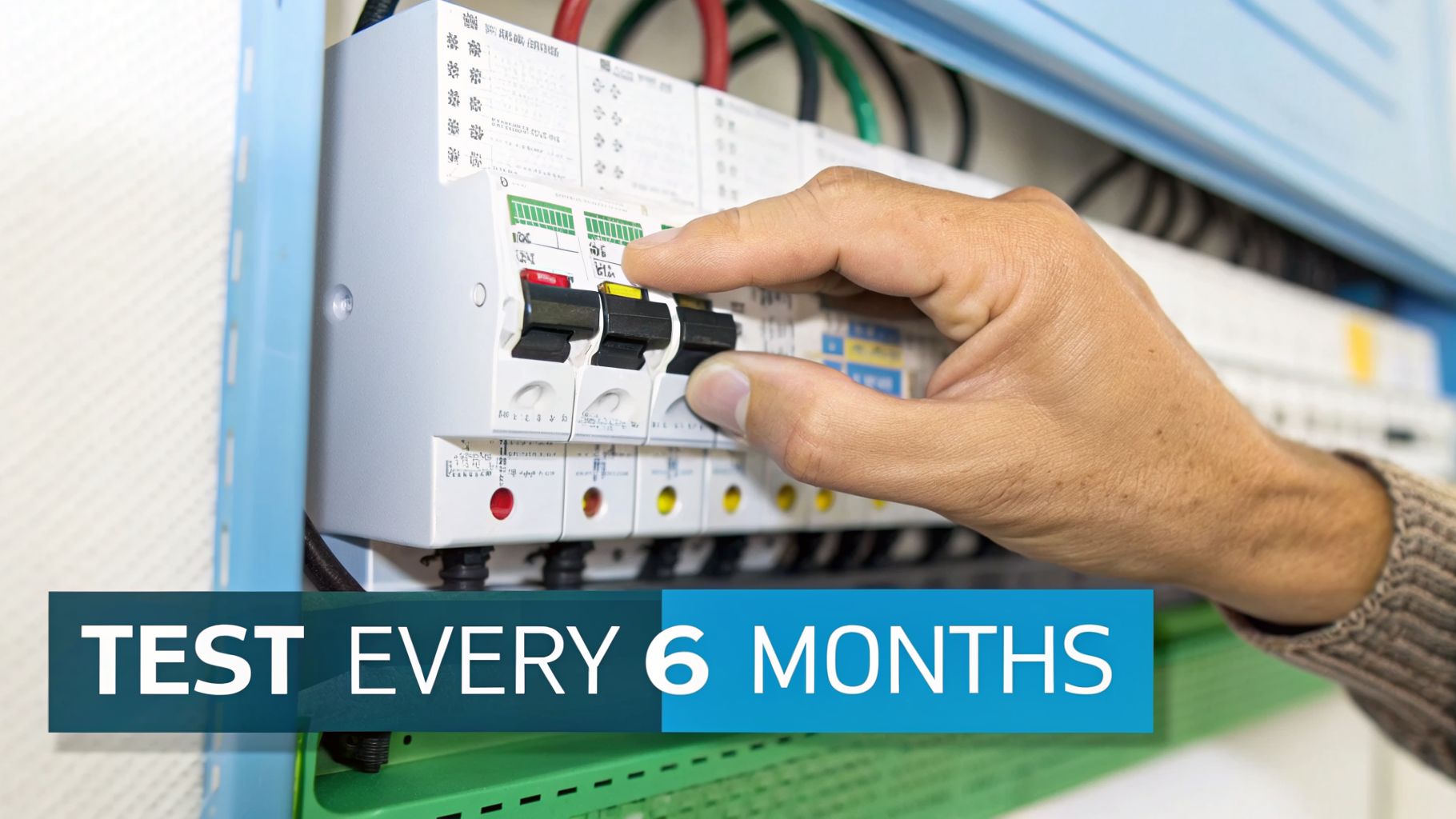
When you hit that button, the switch should flick off instantly, cutting power to whatever circuit it’s protecting. That little click tells you the internal mechanism is working as it should. If it doesn’t trip? That device is faulty and won’t protect you when you need it most. It needs to be replaced by a licensed electrician as soon as you can.
Upgrading for Full Circuit Protection
Real electrical safety isn’t just about having one or two safety switches. Many homeowners miss this, but current Queensland regulations require all circuits coming from your switchboard to have RCD protection. That includes your lights, air conditioning, oven, and even solar power systems. Imagine you’ve got a pre-2000 weatherboard in Redcliffe with an old fuse box. It might have had a safety switch put on the power point circuits years ago, but that’s often where the protection stops.
This leaves major circuits dangerously exposed, such as lighting, air conditioning units, and fixed appliances like your oven or hot water system. A fault in any of these could become a serious hazard without RCD protection.
The reality is that a huge number of Australian homes are under-protected. Many people think they’re safe because they see a safety switch in their board, not realising their lighting or air conditioning circuits are completely exposed to faults.
This safety gap is much wider than most people think. A 2016 analysis uncovered a shocking deficit of around 30 million safety switches needed to bring Australian homes up to a safer standard. The data showed millions of homes built before 2001 likely need several more safety switches to get full protection across all circuits. You can explore the findings of this report to see the full scope of the problem.
The Modern Switchboard as a Safety Hub
Upgrading to a modern switchboard isn’t just about ticking a compliance box; it’s a fundamental investment in your family’s safety. A modern board gives every single circuit its own RCD protection. That means a fault on your air conditioner won’t plunge your whole house into darkness, taking out the lights and fridge too.
This is especially critical for homes with modern energy needs. For example, if you’re getting solar panels or an EV charger installed at your property in Logan, these systems have specific requirements under the AS/NZS 3000 Wiring Rules. A licensed electrician will ensure your board has the capacity and safety devices to handle the new load, preventing a future safety switch tripped scenario and ensuring your home’s electrical system is safe, compliant, and ready for whatever comes next.
Got Questions About Your Safety Switch? We’ve Got Answers.
As licensed electricians on the ground in Brisbane, we field a lot of questions about safety switches. It’s one of those things you don’t think about until it trips. Here are some of the most common queries we get from homeowners just like you.
Is It Normal for a Safety Switch to Trip During a Storm?
Absolutely. It’s actually one of the most common times for a trip to happen. During a heavy downpour, water can find its way into outdoor power points or light fittings. This is especially true in suburbs near the water, like Redcliffe or Wynnum, where the salty air can corrode the seals on outdoor electrical gear over time. Even a nearby lightning strike can be enough to cause a small power surge that makes sensitive electronics create a tiny earth leakage, which is exactly what a safety switch is designed to detect.
If it resets easily after the storm has passed and stays on, you’re likely in the clear. But if it keeps tripping, that’s a red flag. It means water has probably pooled somewhere it shouldn’t, creating an ongoing hazard. In that case, you need to call a licensed electrician to safely track down and fix the source of the problem.
What Is the ‘T’ Button on My Safety Switch for?
That little ‘T’ button stands for ‘Test’, and it’s a crucial part of keeping your home safe. Think of it as a drill to make sure your switch is ready for a real emergency. The Electrical Safety Office (ESO) in Queensland recommends pushing this button every six months. When you press it, the switch should snap to the ‘OFF’ position instantly, cutting the power to that circuit.
If you push the button and nothing happens, the switch is faulty. It won’t protect you or your family from an electric shock. It needs to be replaced by a qualified sparky as soon as you can.
What Is the Difference Between a Safety Switch and a Circuit Breaker?
This is a great question, and it’s something a lot of people get mixed up. They protect against two very different types of electrical dangers.
A safety switch (RCD) is your personal protection. It’s looking for tiny electrical current leaks that could otherwise pass through a person, and it shuts off the power in a fraction of a second to prevent electrocution. A circuit breaker, on the other hand, protects your home’s wiring and appliances from overload or a major short circuit.
In short, a safety switch protects people, and a circuit breaker protects the property. Any modern, compliant switchboard in Queensland must have both.
Can I Just Reset a Tripped Safety Switch and Ignore It?
You should never just ignore a switch that keeps tripping. A single trip that resets easily might just be a one-off glitch from an older appliance starting up. But if it’s happening frequently or it won’t stay on, it’s your electrical system’s way of screaming for help.
Ignoring a persistent trip is a huge gamble. You’re leaving your family exposed to the risk of a serious electric shock and your home vulnerable to an electrical fire. Always try to find the cause. If you can’t, or the switch simply refuses to reset, it’s time to call in a professional. To get an idea of what’s involved, take a look at our guide on electrician costs in Brisbane.
If you’re staring at a tripped safety switch that won’t play ball or you just have a gut feeling that something isn’t right with your home’s wiring, don’t risk it. The licensed and experienced team at AdVoltage Electrical is here to help.


