
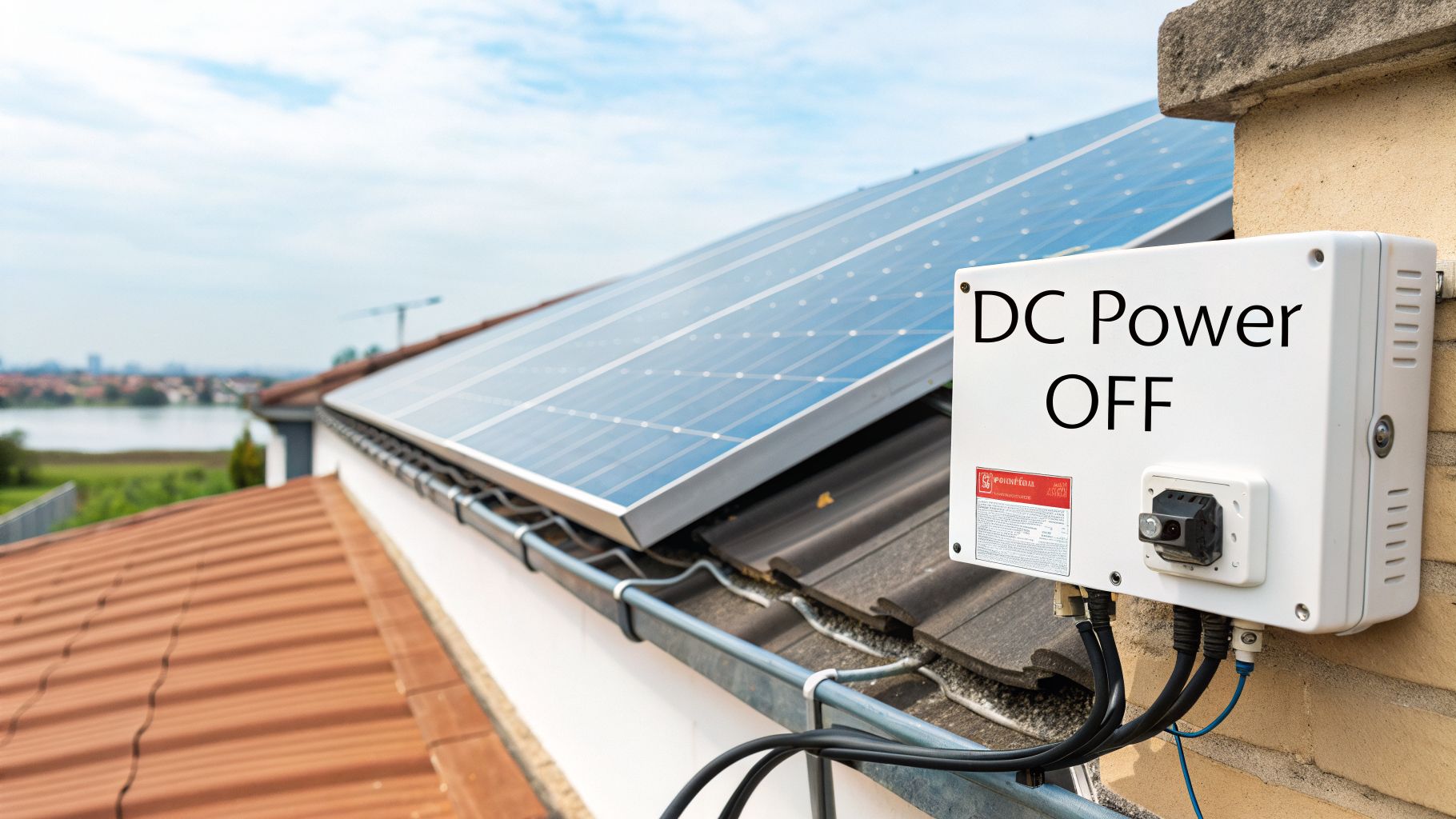
Think of the DC isolator switch as the emergency brake for your solar power system. It’s a simple, manual switch with a crucial job: to completely stop the flow of powerful DC electricity from your solar panels down to your inverter. This isn't just a nice-to-have gadget; it's a non-negotiable safety feature required by Australian Standards to protect you and any electrician working on your system.
Your Solar System's Most Important Safety Switch
For professional help, our team provides solar repairs in Brisbane.
While your solar panels are soaking up that glorious Queensland sun, they’re constantly generating Direct Current (DC) electricity. Unlike the Alternating Current (AC) powering your kettle and telly, this raw DC power from the panels doesn't just switch off when you flip a breaker inside. As long as there's daylight, it's live.
That's precisely where the DC isolator steps in. It creates a physical break in the circuit—a visible air gap that electricity simply can’t jump across. This allows a licensed electrician to safely de-energise the system for maintenance, repairs, or during an emergency. Working on a live solar system without one would be incredibly dangerous.
Why It's A Legal Requirement
Here in Australia, installing DC isolators is strictly mandated under AS/NZS 5033. This regulation is all about keeping homeowners, electricians, and emergency services personnel safe.
Consider this scenario: a house fire breaks out in a Logan home with solar panels. Firefighters need a fast, reliable way to shut down all power sources, including the electricity still being generated on the roof. That clearly labelled DC isolator gives them that ability, making a hazardous situation much safer for everyone. It serves a different purpose to other safety switches in your switchboard; you can learn more about the role of a residual current device in our separate guide.
Key Functions Of A DC Isolator
At its core, a DC isolator provides a clear point of disconnection for the DC side of your solar setup. This is vital for a few key reasons:
- Routine Maintenance: It allows electricians to safely clean panels, check wiring, or service your inverter without live power.
- Emergency Shutdown: It offers a quick way to cut all power coming from the panels during a fault, fire, or other crisis.
- System Repairs: Guarantees the system is completely dead before anyone starts work on the inverter or cabling.
- Compliance: It ensures your system meets the strict safety requirements of the Electrical Safety Act 2002 and Australian Standards.
For any homeowner across Brisbane and South East Queensland (postcodes 4000-4999), from the hot inland suburbs of Ipswich to the salty air of Redcliffe, understanding this switch is the first step to ensuring your solar investment is safe. It’s not an optional extra—it’s a fundamental part of a compliant and secure solar PV system.
The Critical Role of DC Isolators in Queensland Solar Safety
To get why a DC isolator switch is such a big deal, you first need to understand the kind of power your solar panels are making. The electricity coming off your roof is Direct Current (DC), which is a completely different beast to the Alternating Current (AC) that powers your kettle and telly.
Think of DC electricity as a constant, one-way river of energy. If you try to stop that flow without the right kind of switch, the electricity can literally jump across the gap. This creates a DC arc—a super-hot, sustained plasma discharge. It’s basically a small, man-made bolt of lightning, and it’s a massive fire risk.
The Dangers of DC Arc Faults
Picture a tired old DC isolator on a house in Redcliffe, getting blasted by salty air and moisture day after day. If water seeps inside, it can create a shortcut for that powerful DC electricity, potentially sparking a fire right there on your roof. This isn't just a 'what if' scenario; it's a very real danger that highlights why quality parts and professional installation are non-negotiable.
This is precisely why all electrical work on your solar system is illegal and life-threatening to perform yourself. Under Queensland's Electrical Safety Act 2002, only a licensed and accredited solar installer can legally and safely work on these high-voltage DC systems. The Electrical Safety Office (ESO) of Queensland is crystal clear about the severe risks involved for anyone attempting DIY work.
A Look at the Alarming Statistics
The fall-out from faulty or badly installed DC isolators is well-documented, and the numbers are genuinely concerning. For years, these little switches have been singled out as a leading cause of solar-related fires right across Australia.
In New South Wales, solar-related fires jumped five-fold over a recent five-year period, with a shocking 20% increase year-on-year. Digging into the data, over half of these fires were traced directly back to faulty DC isolator switches. This points to a critical weak point in many systems, often down to cheap components or a shoddy installation job.
It's not a new problem, either. Historical data shows that between 2009 and 2015, DC isolators were responsible for anywhere between 38% and 50% of all solar fires in Western Australia and NSW. The issue became so widespread that the Australian Competition and Consumer Commission (ACCC) had to step in and issue recalls for several common brands due to the fire hazard they posed. You can see more on how solar safety standards in Australia are evolving to tackle these problems head-on.
Why Professional Installation is Non-Negotiable
A licensed electrician does far more than just flick a switch on. They are responsible for making sure the entire DC circuit is safe, compliant, and tough enough to handle our harsh South East Queensland climate. This means choosing the right IP-rated enclosure to keep moisture out, making sure every connection is torqued to perfection, and placing the isolator where it can be accessed safely in an emergency.
It doesn’t matter if you're in a new build out in Ipswich or an older home in Moreton Bay, a professional’s expertise is your single best defence against the unseen dangers of DC power. Hiring a qualified and experienced solar installer in Brisbane is the most critical decision you'll make for the safety and performance of your solar investment. It’s not just about ticking a box for compliance—it’s about protecting your home and your family.
Choosing the Right DC Isolator for Brisbane's Climate
Not all electrical bits and pieces are made the same, and that’s especially true for the DC isolator switch here in South East Queensland. Our climate is pretty unique—and brutal on outdoor gear. From the scorching summer heat out in Ipswich to the soupy, subtropical humidity in Brisbane and the salty air along the Moreton Bay coast, anything left outside is put under serious pressure. A cheap, flimsy isolator just won't last.
When we talk about how well a component can handle the weather, we’re looking at its Ingress Protection or IP rating. Think of it as a toughness score. This two-digit code tells you exactly how well the outer casing protects the important electrical bits inside from solids (like dust) and liquids (like rain).
Why the IP Rating Is So Important
For any DC isolator switch bolted to a roof or wall outdoors in the 4000-4999 postcode area, an IP66 rating is the absolute minimum you should be looking for. That first '6' means it's completely sealed against dust. The second '6' tells you it can handle powerful jets of water from any direction. That might sound like overkill, but it's what's needed to survive a classic Brisbane summer thunderstorm.
Picture this: a cheap, non-compliant isolator with a poor IP rating gets installed on a roof in the Redlands. After a few months of morning dew, relentless sun, and a couple of proper downpours, its seals give way. Moisture creeps inside, the metal components start to rust, and before you know it, you've got a short circuit just waiting to happen—a serious fire risk. Spending a little extra on a properly rated unit from the get-go is just common sense.
Look for Certified Quality
Beyond just being weatherproof, your DC isolator must be certified to meet Australia's strict safety standards. This is your proof that the product has been properly tested and is fit for purpose. Always check that any isolator installed on your property meets these two critical benchmarks:
- Australian Standard AS 60947.3: This is the specific rulebook for switches like these. It ensures they can operate safely and reliably, especially under load.
- Clean Energy Council (CEC) Approval: The CEC keeps a list of approved gear that meets Australia's high bar for safety and quality. Using CEC-approved parts is also often a must if you want to claim any government solar rebates.
Choosing a unit that ticks both these boxes is non-negotiable. It means the switch you’re counting on to keep your home safe has been put through its paces and won't let you down when it matters most.
Compliant vs Non-Compliant Isolators
The difference between a high-quality, compliant DC isolator and a cheap, uncertified one is night and day. It’s not just about the price tag; it’s about the materials, the engineering, and ultimately, the safety of your home and family. A professionally installed, compliant switch is a small investment that buys you a massive amount of peace of mind.
For anyone with a solar system in Brisbane, choosing CEC-approved DC isolators is the smart move. Take the ONCCY EDS5/6 series, for example—it's got its AS 60947.3:2023 SAA certification and comes with IP66 protection, an ultra-fast 5ms switch-off time, and a tough -40℃ to +70℃ operating range. This is the kind of gear that’s built for our climate and meets all the rules. You can discover more about how these standards protect your system and see why quality really does matter.
To make it even clearer, here’s a quick comparison of what to look for and what to run a mile from.
Compliant vs Non-Compliant DC Isolator Features
| Feature | High-Quality Compliant Isolator | Low-Quality Non-Compliant Isolator |
|---|---|---|
| Certification | Clearly marked with AS 60947.3 and on the CEC approved list. | Lacks proper certification markings or uses fake labels. |
| IP Rating | IP66 or higher, designed for outdoor use in harsh conditions. | Often IP54 or lower, unsuitable for direct exposure to rain. |
| Housing Material | Made from UV-stabilised, impact-resistant polycarbonate. | Made from brittle, cheap plastic that cracks under the QLD sun. |
| Internal Parts | Uses robust, self-cleaning contacts to prevent corrosion. | Features flimsy internal components prone to failure and overheating. |
| Safety Mechanism | Has a genuine load-breaking capacity to extinguish DC arcs. | May fail to interrupt the current safely, creating a fire hazard. |
| Warranty & Support | Backed by a reputable manufacturer with a solid Australian warranty. | Typically sold with no warranty or support from an unknown brand. |
At the end of the day, the DC isolator you choose has a direct impact on the safety and lifespan of your entire solar PV system. Insisting on a high-quality, compliant, and properly weather-resistant model is one of the most important things you can do to protect your investment and keep your system running safely for years to come.
Proper Location and Installation of Your DC Isolator
Figuring out where to put your DC isolator switch isn't just about what looks neat or is out of the way; it's a critical safety decision, and one that’s strictly governed by Australian Standards. The whole point of its placement is to guarantee quick and safe access for electricians doing maintenance and, even more importantly, for emergency services if a crisis hits. It’s exactly why this job is strictly for licensed professionals.
The AS/NZS 3000 Wiring Rules, along with specific solar standards, lay it all out. As a general rule, your solar PV system will need at least two DC isolators. One has to be located right next to the solar inverter, and another is usually required up on the roof, close to the solar panels themselves. This setup creates a vital redundancy, ensuring there's always an accessible way to kill the power.
Why Location Is a Matter of Safety
Picture this: a fault sparks a small fire at a commercial property in Morningside. When the fire crews roll up, their first job is to make the scene safe by shutting down all electricity. A clearly labelled DC isolator on the roof lets them instantly stop the power flowing from the panels, dramatically cutting the risk of electric shock while they tackle the blaze.
The same principle applies to a classic Queenslander in Coorparoo. If an electrician needs to service your inverter, having an isolator within arm's reach means they can safely cut the DC power before their hands go anywhere near a tool. That kind of accessibility is a cornerstone of electrical safety design.
This graphic shows the non-negotiable features every professionally installed DC isolator should have.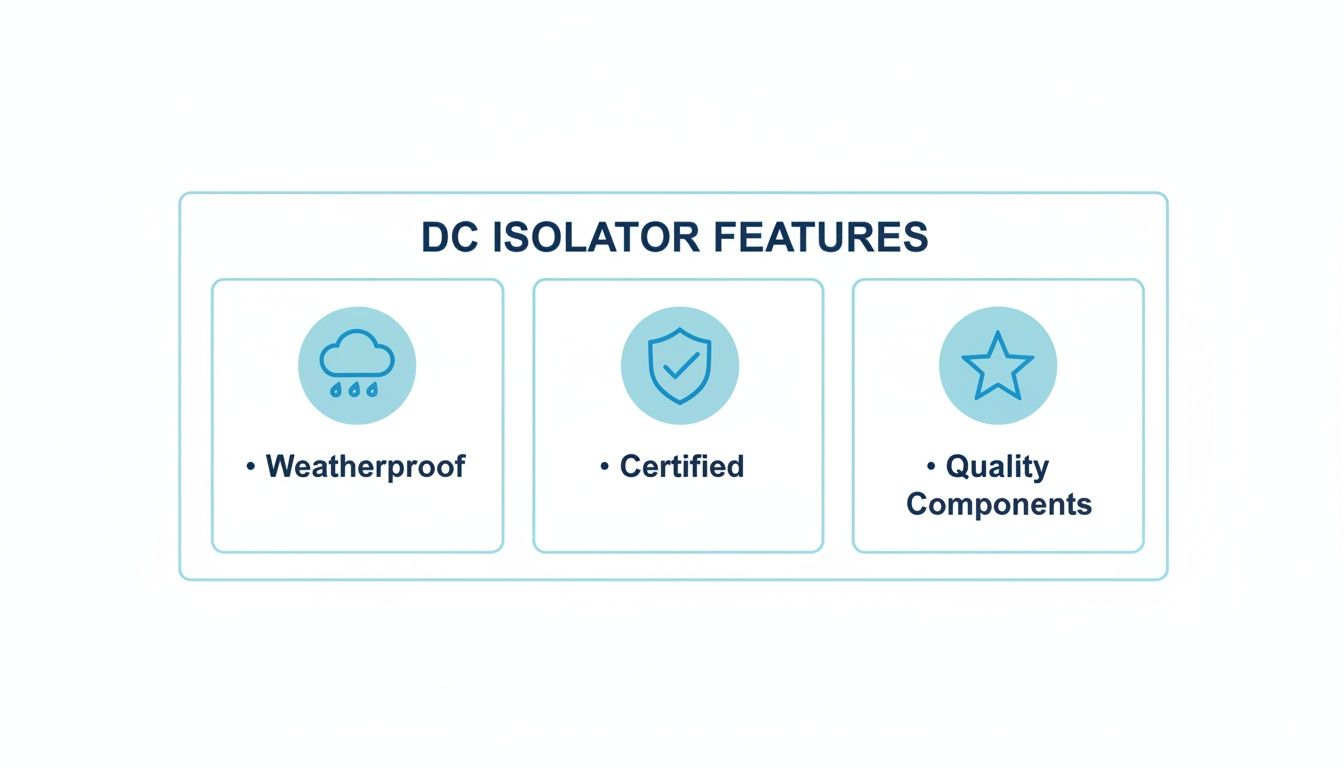
These elements—proper weatherproofing, official certification, and quality components—are what ensure your isolator will do its job safely for years.
The Dangers of Incorrect Installation
An incorrectly installed DC isolator is, frankly, more dangerous than not having one at all. It's not just about putting it in the wrong spot. Improper wiring and poor sealing are just as big a deal. For instance, if the cable glands aren't sealed tight, moisture will get inside the unit. In Brisbane’s humid climate, that's a recipe for disaster, leading to corrosion, short circuits, and a very real fire risk.
A licensed electrician is trained to make sure every single part of the installation is up to code. That means using the right weather-rated enclosure, ensuring every connection is torqued correctly, and mounting the unit on a non-combustible surface where needed. It’s this meticulous attention to detail that separates a safe, professional job from a dangerous, illegal one.
On top of that, correct labelling is a legal requirement. Emergency services and electricians need to identify the switch and what it does in a split second. Faded, wrong, or missing labels can cause dangerous delays when every moment counts. When it comes to the safety of your property and the people working on it, there are no shortcuts. To make sure you’re getting a true professional for the job, it's always a good idea to check out our guide on finding the best electrician in Brisbane.
Common Problems and Maintenance Needs for DC Isolators
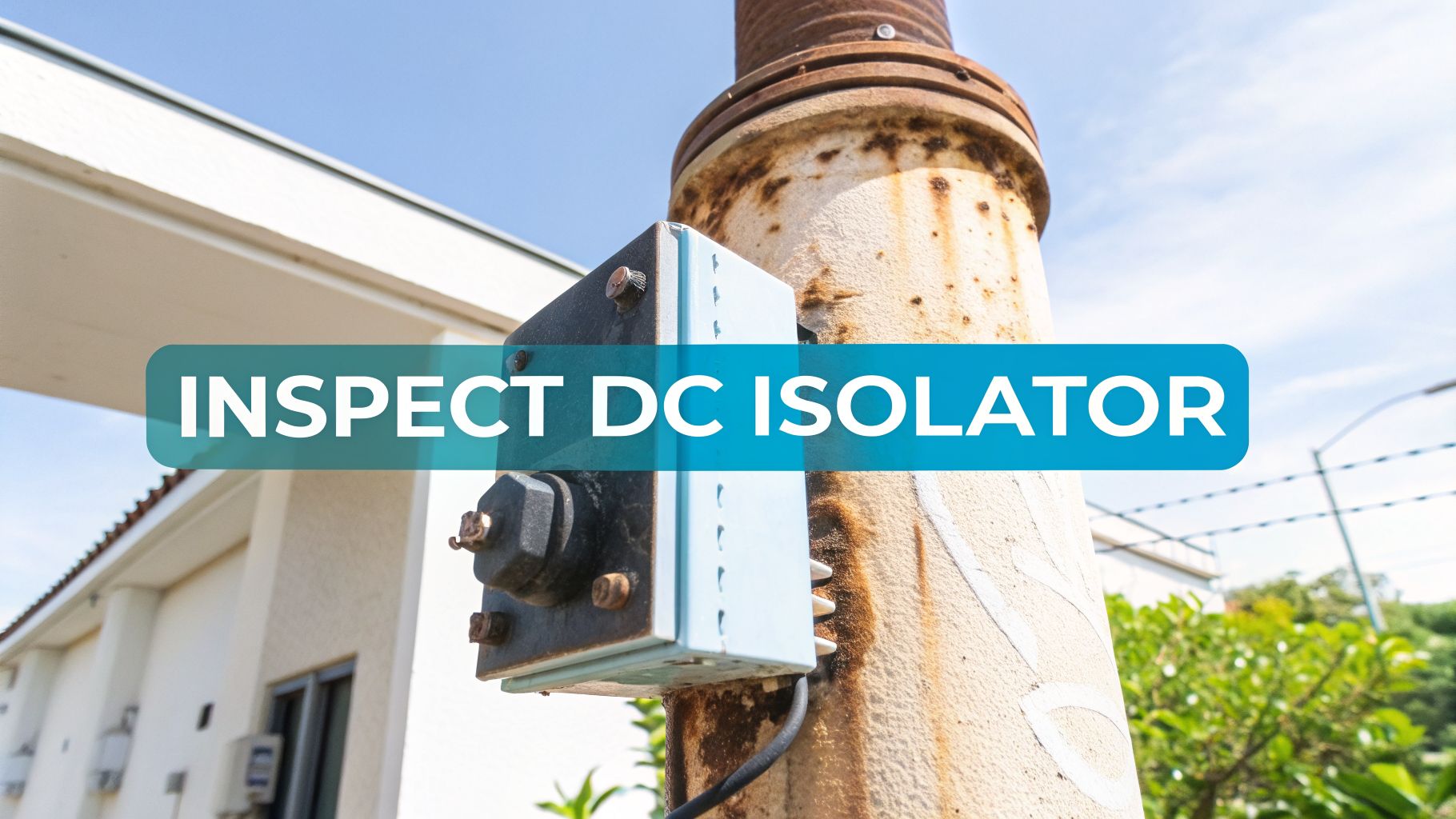
Even the best-installed solar systems need a check-up now and then, and the humble DC isolator switch is often the first component to show its age. Because it’s usually mounted right out in the open on your roof or an external wall, it cops the full force of our demanding South East Queensland climate. Knowing what to look for can help you spot trouble early.
The biggest enemy of any DC isolator? Water. Brisbane’s classic subtropical humidity, combined with our heavy downpours and wild storm season, constantly puts the unit's weatherproof seals to the test. Once moisture sneaks inside, it’s bad news. It causes corrosion on the metal contacts and terminals, which can lead to a short circuit and a serious fire risk. This is exactly why a high IP rating is non-negotiable.
The Impact of the Queensland Sun
Another major issue we see all the time is UV degradation. The relentless Queensland sun is incredibly harsh on cheap plastics. Over many years, UV radiation will break down the outer casing of a poor-quality DC isolator, making it brittle and prone to cracking.
These cracks then become little gateways for rainwater and dust, compromising the sensitive components inside and putting the unit on a fast track to failure. What starts as a tiny hairline fracture can quickly turn into a massive safety hazard. It’s why quality, compliant units are always made from UV-stabilised materials.
Internal Failures and Component Quality
Sometimes, the problem isn’t what you can see on the outside, but what’s happening on the inside. Cheaper, non-compliant isolators are often built with flimsy internal switching mechanisms and low-grade parts that just can't handle the high-voltage DC load day in, day out. These can fail without any obvious external warning signs until it's far too late.
This is where regular professional inspections really prove their worth. Even a perfectly installed system can run into issues down the line. A Victorian inspection back in 2018 looked at 2,234 systems and found that 0.6% had potentially unsafe DC isolators. It’s a small number, but it highlights that even as products get better, ongoing vigilance is key.
Crucial Safety Warning: A faulty DC isolator isn't just an inconvenience; it's a significant fire risk. If you notice any of the warning signs listed below, do not touch the switch or attempt to open the casing. Call a licensed electrician immediately to assess the situation safely.
Visual Warning Signs to Look For
You don't need to be an electrician to spot the early signs of a failing DC isolator. A quick visual check from the ground every few months can help you catch a problem before it gets serious.
Here’s what to keep an eye out for:
- Discolouration or Brown Marks: Any browning or scorching on the plastic casing is a huge red flag. It’s a dead giveaway that things are getting way too hot inside.
- Cracks or Physical Damage: Scan the housing for any visible cracks, chips, or breaks, paying close attention to the seals and where the cables enter.
- Signs of Water Ingress: Can you see any moisture or condensation inside the little viewing window on the switch? If so, the weatherproof seal has failed.
- Melting or Warping: If the plastic housing looks melted, warped, or bent out of shape, it’s a clear sign of extreme internal heat.
Spotting any of these issues means it's time to pick up the phone and call a professional. These are often symptoms of deeper, more common electrical problems in Brisbane homes that need an expert eye. At the end of the day, regular maintenance is the best way to make sure your whole solar system—and its most critical safety switch—keeps running safely and efficiently for years to come.
When to Call a Licensed Brisbane Electrician for Your DC Isolator
While it’s great to know what a faulty DC isolator switch looks like, it's absolutely critical to understand that identifying a problem is where your job ends and a professional's begins.
Under Queensland law, any work beyond a quick visual check—that means opening the cover, testing, or replacing the unit—is strictly illegal and incredibly dangerous if you’re not a licensed sparky. That powerful DC current flowing from your panels doesn’t just stop because a cloud passes over the sun.
Think of it this way: you can check the oil level in your car, but you wouldn't try to rebuild the engine on your own driveway. It’s the same principle here. A licensed electrician has the right tools, the proper testing equipment, and most importantly, the training to de-energise and work on your solar system safely.
Clear Signs It's Time to Call Us
Some situations are simply non-negotiable and demand a professional's attention straight away. Don’t hesitate to get on the phone if you run into any of these scenarios.
- During Any New Solar Installation: The entire installation, from the panels to the inverter and the correct placement of the DC isolator, must be done by a CEC-accredited electrician to make sure it complies with Australian Standards.
- Upgrading or Modifying Your System: If you’re adding more panels, hooking up a battery, or upgrading your inverter, the DC isolator will need a proper assessment. It might even need to be replaced to handle the new electrical load.
- If You Spot Any Visual Damage: If you notice any of the warning signs we’ve talked about—like cracking, discolouration, melting, or moisture inside the casing—it’s time to get a professional out to look at it immediately.
- For Routine Safety and Performance Checks: We strongly recommend a full solar system inspection every 12 to 24 months. This is especially important here in Brisbane, where our intense sun and hectic storm season can really speed up wear and tear on components.
Your Safety is the Priority: A faulty or aging DC isolator isn't just a minor issue; it's a serious fire hazard. Trying to fix it yourself is not only illegal under the Electrical Safety Act 2002 but could have devastating consequences for your home and family.
At AdVoltage Electrical, our team services homes all across Brisbane North and South, from Redcliffe right through to the Redlands. Our focus is on protecting your solar investment with high-quality, compliant parts and honest, safety-first advice.
If you have any concerns at all about your solar system's safety, you can learn more about essential electrical repairs from your local Brisbane electrician in our other articles. Never, ever take a chance with DC power.
FAQ About DC Isolator Switches
We get a lot of questions about the different bits and pieces that make up a solar power system, and the DC isolator switch is always a hot topic. To help clear things up, we've put together answers to some of the most common queries we hear from homeowners across Brisbane and South East Queensland.
How Often Should I Have My DC Isolator Inspected?
It’s a good habit to give your isolator a quick visual check every few months – just look for any obvious cracks, yellowing, or signs of heat damage.
For a proper deep dive, though, we recommend a full inspection by a licensed electrician as part of a complete solar system health check every 12 to 24 months. This is especially important here in the Brisbane area, where our blistering sun and wild storm season can really put outdoor components through their paces. A professional will get inside the unit to make sure the seals and internal wiring are still in top shape.
Can I Operate the DC Isolator Switch Myself?
Absolutely. You definitely can and should know how to use your DC isolator. It's the big red "off" switch for your panels, and you'll need to use it for emergency shutdowns or before any maintenance. Your original installer should have walked you through how to do this safely.
But that’s where your involvement ends. Any work involving opening the cover—inspecting the wiring, testing, repairing, or replacing the unit—is strictly electrical work. In Queensland, this must only be done by a licensed electrician. Trying to open it yourself isn't just illegal; it's incredibly dangerous due to the live DC voltage flowing from your panels.
My Solar System Was Installed Before 2012, Do I Need an Isolator?
If your system went up before the AS/NZS 5033 standard was updated in 2012, it might not have the same rooftop DC isolator setup as modern installations. For example, a system installed on 01/01/2011 might have been perfectly compliant for its time, but safety standards have come a long way since then.
We strongly recommend getting any older solar system assessed by a licensed electrician. They can check if retrofitting DC isolators is a good idea to bring your system up to current safety best practices. It’s a small investment for peace of mind and the protection of your home.
This kind of proactive check-up ensures your older system, whether it's in Carindale or out in Wynnum, is as safe as it can be, protecting your family and your investment for years to come.
If you've got more questions or you think your DC isolator switch might need a professional eye, don't hesitate to get in touch. The team at AdVoltage Electrical is here to give you expert advice and make sure your solar system is safe, compliant, and working at its best.


