
Let's cut straight to the chase: the upfront 10kW solar power system price in Brisbane averages around $8,630 after you factor in the federal rebate. For a large household, this investment often pays for itself in just 4-6 years through massive savings on your electricity bills.
So, what is the real cost of a 10kW solar system in Brisbane? When you first start looking into solar for your home, the numbers can feel a bit all over the place. But figuring out the cost of a 10kW system in South East Queensland is actually more straightforward than you might think. It’s not just about the sticker price; it's about the incredible long-term value and quick return on investment that our sunny climate makes possible.
If you would rather leave it to a licensed electrician, see our solar installation in Brisbane service.
A 10kW system is a real workhorse, making it a perfect match for larger families or homes that use a lot of power. Imagine a family home in Ipswich with ducted air conditioning blasting through summer, or a house in Redcliffe with a pool pump humming away for hours each day. These are the kinds of high-energy households that can truly maximise the benefits of a powerful 10kW setup.
Understanding the Upfront Cost
That advertised price you see almost always has a major point-of-sale discount built-in. This comes from the federal government’s Small-scale Technology Certificate (STC) scheme. Your installer—like us here at AdVoltage Electrical—handles all the confusing paperwork and applies this discount directly, saving you thousands right from the get-go.
This quick snapshot breaks down the key figures for a typical 10kW system here in Brisbane.
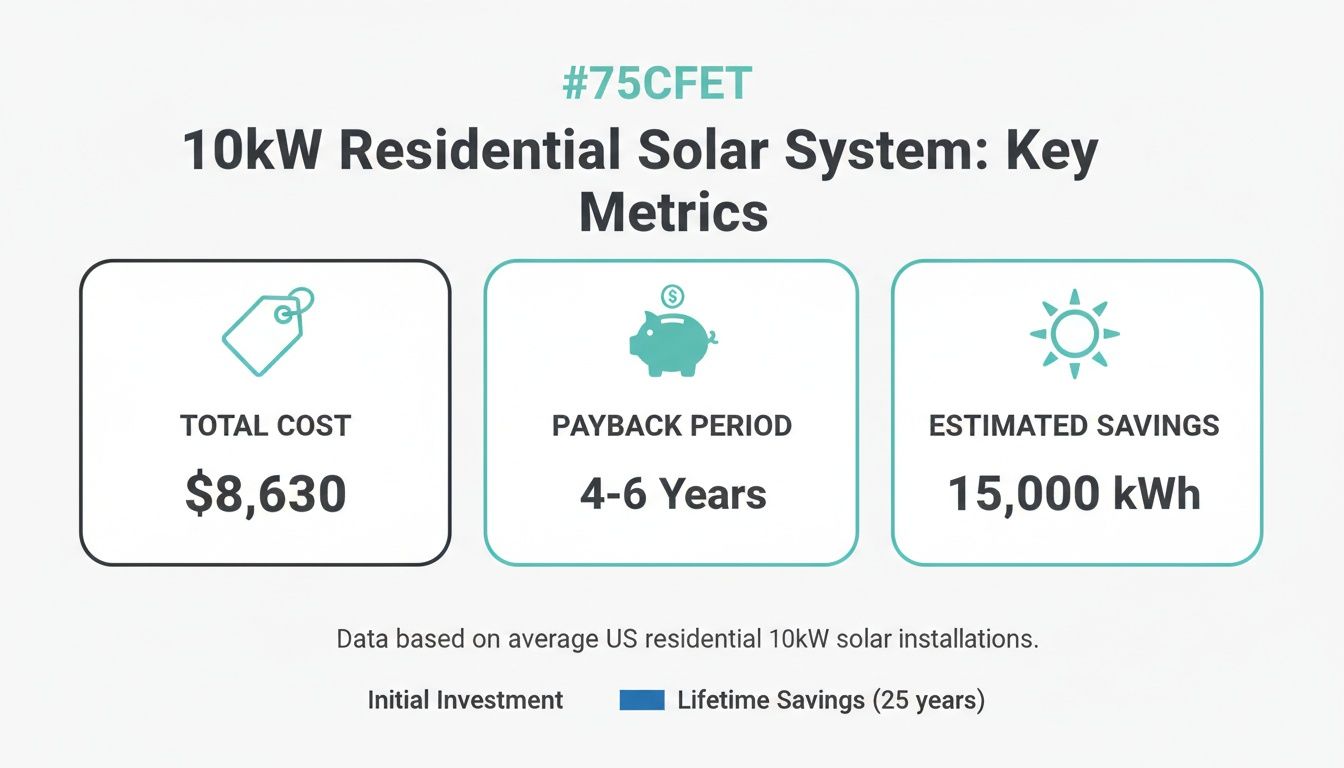
As you can see, a one-time investment quickly translates into years of energy savings and a surprisingly fast payback.
Price Trends and Payback Periods
The great news for homeowners is that solar technology keeps getting more efficient and a lot more affordable. As of early 2024, the average cost for a quality 10kW system sits at approximately $8,630 after the STC rebate is applied. This marks a significant drop of about 9% since late 2022, mostly thanks to smarter installation practices and more stable supply chains.
The table below gives you a quick overview of what to expect for a standard 10kW solar system in Brisbane.
10kW Solar System Price Snapshot for Brisbane (2024)
| Metric | Average Figure |
|---|---|
| Gross System Cost | $12,030 |
| Federal STC Rebate | -$3,400 |
| Final Price (After Rebate) | $8,630 |
| Price per Watt | $0.86 |
| Annual Energy Generation | 14,000 – 16,000 kWh |
| Estimated Payback Period | 4 – 6 years |
These figures show just how accessible and rewarding a 10kW system has become for Brisbane families.
In Queensland's sun-drenched conditions, a 10kW system can generate a massive 14,000 to 16,000 kWh of electricity each year. For most of our clients, this leads to a full payback on their investment in as little as four to six years. Once you hit that payback milestone, every single kilowatt of electricity your system generates is essentially free power.
Of course, the installation cost is just one piece of the puzzle when it comes to your home's electrical setup. For a broader look at what to expect, feel free to check out our guide on electrician costs in Brisbane.
Decoding Your Quote: What Influences the Final Price?
When you start getting solar quotes, you'll probably notice the final numbers can be all over the place. This isn't just different companies trying to undercut each other; it’s because the final 10kW solar power system price is shaped by a few key factors. Getting your head around these variables helps you compare quotes properly and know exactly what you're paying for.
It really boils down to the fact that not all components are created equal. This is where a huge chunk of the cost difference comes from. The solar panels and the inverter are the heart and brains of your system, and they each come in different tiers of quality, performance, and, you guessed it, price.

Solar Panel Tiers Explained
It helps to think of solar panels a bit like cars. You’ve got your premium, high-performance brands known for their leading-edge tech and rock-solid reliability, and then you have more budget-friendly options that still get the job done well.
- Tier 1 Panels: These are the top-shelf products from major, financially stable manufacturers. They typically offer the highest efficiency (meaning more power from a smaller space) and come with impressive 25-30 year performance warranties. For a 10kW system, choosing Tier 1 panels will push your quote towards the higher end, but you're really investing in long-term performance and peace of mind.
- Other Tiers: Panels outside of Tier 1 can bring the price down to a more accessible point. Don't worry, they still have to meet strict Australian Standards to be sold here. While their efficiency might be a touch lower or their warranties a bit shorter, they often provide fantastic value and are a very popular choice for many Brisbane homeowners.
The Brains of the System: The Inverter
The inverter is the clever box that turns the DC power your panels create into the AC power your home actually uses. The type of inverter you go with has a massive impact on both the upfront cost and how your system performs over its lifetime.
For example, imagine you own a classic Queenslander in New Farm with a tricky roof that has multiple angles and a few trees casting shade. A standard string inverter, which links all your panels together in a series, would really struggle. If just one panel gets shaded, the output of that entire string of panels plummets.
For a roof like that, microinverters are a much smarter choice. Each panel gets its own little inverter, so the performance of one doesn't drag the others down. This setup does cost more upfront, but you'll squeeze every last drop of energy out of a complex roof. Then there’s the hybrid inverter, which is a must-have if you plan to add a battery now or down the track, as it's specifically designed to juggle power between your panels, the grid, and a battery.
Why It Matters: Your inverter choice directly affects how much power your system actually generates over its 25-year lifespan. A cheap, mismatched inverter on a complex roof could cost you thousands in lost savings. Getting this right from the start is a critical investment.
Your Home's Unique Characteristics
Finally, your property itself plays a huge part. The complexity of the installation—things like your roof material, its pitch, and how easy it is to access—will affect labour costs. A steep, tiled roof on a two-storey home in the Redlands is a much bigger and more time-consuming job than a low-set, tin-roofed house in Logan.
Your existing electrical setup is also a massive factor. Let's say your home in Redcliffe was built before 2000 and still has an old ceramic fuse box. To safely connect a powerful 10kW solar system, your switchboard will need a mandatory upgrade to meet the AS/NZS 3000 wiring rules, which includes installing modern safety switches. To see why this is so important for safety, you can learn more about what a residual current device is and why it's non-negotiable. This isn't an optional extra; it's a legal requirement to keep your home and family safe.
The Long-Term Value and Payback of Your Solar Investment
When you’re looking at the 10kW solar power system price, it’s easy to get fixated on that initial number. But that’s only half the story. A quality solar system isn’t just an expense; it's a powerful financial asset that starts generating returns from day one and continues for decades. Think of it as an investment in your home’s future, one that actively puts money back into your pocket.
Let’s zoom out and look at the bigger picture. The cost of going solar has absolutely plummeted over the last ten years, making it more accessible than ever for Brisbane families. We’re not talking about a small dip—it's a massive shift that has changed the game for homeowners across the country.
Solar Is More Affordable Than Ever
Over the past decade, the price of a 10kW solar system has dropped by more than 60%. If you were looking to install one back in 2012, you would have been staring down a price tag of around $2.40 per watt, putting a 10kW system at a staggering $24,000.
Fast forward to today, and that price has fallen to just $0.86 per watt. That huge drop has made solar a realistic and incredibly smart financial move. You can see a great breakdown of how solar panel costs have evolved on Volteam's blog.
This new affordability is why solar has exploded in popularity. More than 3.5 million Australian homes now have solar panels, and Queensland is leading the pack with over 40% of households harnessing the sun's power. It’s clear proof that solar is no longer a niche choice but a mainstream, savvy way for families to get a handle on their power bills.
Calculating Your Payback Period
So, how long until your system pays for itself? This is what we call the "payback period"—the point where your savings on power bills equal what you initially spent. Once you hit that milestone, every kilowatt of energy your system generates is pure profit.
Let's walk through a real-world scenario to see how it works.
Consider this scenario: A family in a newer estate in Ipswich has a large home and relies heavily on their ducted air con to survive those long, dry summers. Their quarterly power bills can be brutal, especially from December to February.
Here’s a simplified breakdown of their potential savings with a 10kW solar system:
- Current Electricity Rate: Around 28 cents per kilowatt-hour (c/kWh).
- Solar Generation: A 10kW system in Ipswich can easily pump out 40-45 kWh on a sunny day.
- Annual Savings: By using this free solar power during the day instead of buying it from the grid, they could save between $2,000 and $3,000 every single year.
With an initial investment of around $8,630, this family could see a full return in just 4 to 6 years. For the next 15 to 20 years of the system's life, that's thousands of dollars in savings annually. They're essentially getting free electricity.
Boosting Your Property's Value
Beyond the immediate bill savings, a professionally installed solar system is a massive drawcard for potential buyers. In a market as sunny as South East Queensland, homes with solar are in high demand. It tells a buyer that the home is modern, energy-efficient, and has lower running costs—a pretty attractive proposition.
A high-quality 10kW system can genuinely increase your property's market value. It's one of the few home improvements that not only saves you money while you live there but can also deliver a fantastic return when it's time to sell. We take a closer look at this in our article about electrical upgrades that boost your Brisbane property's value.
Should You Add a Battery to Your 10kW System?
It’s the number one question we hear from homeowners once they’ve settled on a 10kW system: is adding a battery worth the extra cost right now? Think of it this way. A standard solar setup is brilliant for slashing your daytime power bills. But adding a battery? That transforms you from just a consumer into your own personal power company.
A solar battery is basically a big, rechargeable power bank for your house. During the day, your 10kW system often generates more electricity than you're using. Instead of sending all that excess juice back to the grid for a measly feed-in tariff, a battery captures and saves it. Then, when the sun goes down, your home automatically starts drawing from the battery instead of paying for expensive peak-rate electricity.
The Cost and Value of Energy Independence
Let’s be upfront: adding a battery significantly increases the initial 10kW solar power system price. But for many households, the long-term savings and energy security make it a seriously compelling investment. This is especially true here in South East Queensland, where summer storms can knock out the power grid for hours, or even days.
Let's say a family living in a storm-prone part of Moreton Bay deals with frequent blackouts every summer. For them, a battery isn't just a gadget—it's invaluable peace of mind. During an outage, their home keeps running the essentials like the fridge, lights, and medical equipment, all powered by the sun.
The financial case for batteries is getting stronger all the time. Right now, a complete 10kW solar-plus-battery package can range from $14,000 to $25,000. While the big-name brands have high name recognition, there are some fantastic, affordable modular options using safe and reliable LiFePO4 chemistry that are delivering huge savings. These newer systems can even bring your payback period down to as little as 5 to 7 years, especially when you get smart with your usage to dodge those peak tariffs.
Comparing Your Options
The battery market has a few different paths you can take. You could go for a sleek, all-in-one system from a premium brand, known for seamless integration but a higher price tag. Or, you could opt for a modular system, which lets you start with a smaller capacity and add more storage later. This offers great flexibility and a lower entry cost.
Cost Comparison: 10kW Solar System With and Without a Battery
| Feature | 10kW System Only | 10kW System + 10kWh Battery |
|---|---|---|
| Estimated Cost | $8,500 – $11,000 | $14,000 – $25,000+ |
| Main Benefit | Slashes daytime power bills | Daytime savings plus blackout protection and evening power |
| Typical Payback | 4-6 years | 5-8 years |
| Grid Reliance | High (at night and on cloudy days) | Low to medium |
| Best For | Budget-conscious households with high daytime energy use | Households seeking energy independence, EV owners, and those in storm-prone areas |
Ultimately, deciding whether to add a battery comes down to your priorities and budget. If your main goal is the fastest possible payback, a solar-only system is a great place to start. But if you value energy security and want to squeeze every last drop of power out of your panels, a battery is an excellent addition. Our team of residential electricians in Brisbane can help you weigh the pros and cons for your specific situation.
Navigating Solar Rebates and Incentives in Queensland
Let's be honest, government incentives can feel like you need a special degree just to figure them out. We'll cut through the jargon. When you're looking at the 10kW solar power system price, there are two main programs in Queensland that make a real difference to your wallet: the federal STC scheme and the state's feed-in tariff.
The big one you need to know about is the federal government's Small-scale Technology Certificate (STC) scheme. The most important thing to grasp is that this is not a cash-back offer you apply for later. Instead, think of it as a massive, instant discount that your installer handles for you. It's thousands of dollars slashed directly off the price tag of your new system.
The Upfront Discount: The STC Scheme
When a professional installer like AdVoltage Electrical gives you a quote for a 10kW system, the price you see has almost certainly had this federal rebate applied already. It’s baked right in. STCs are generated based on your system's size and where you are in Australia—luckily, all of South East Queensland (postcodes 4000 to 4999) is in the top zone for solar generation.
Here's the takeaway: Your installer calculates the number of certificates your 10kW system creates, sells them for you, and passes that value on as an immediate discount on your invoice. The exact value of each STC wiggles up and down with market demand, but it consistently delivers a huge saving, often over $3,000 for a 10kW system.
This is the primary financial leg-up available, and it’s what makes the initial investment so much more achievable for Brisbane households. It’s a guaranteed price reduction that dramatically shortens your system's payback period.
Getting Paid for Your Power: The Feed-in Tariff
Once your system is installed and humming away, the next piece of the financial puzzle is the feed-in tariff (FiT). This is simply the rate your electricity retailer pays you for any extra solar power your system generates but your home doesn't use. This unused power gets "fed back" into the grid for your neighbours to use.
While the feed-in tariffs in Queensland aren't the sky-high rates from the early days of solar, they are still an essential part of making the numbers work. On a sunny Brisbane day, your 10kW system will likely be churning out way more power than your home is using, which automatically flows into the main grid. For every single kilowatt-hour (kWh) you export, your electricity retailer gives you a credit on your bill, chipping away at the cost of any power you still need to pull from the grid.
It's definitely worth shopping around for a new power plan when you get solar, as different retailers in Queensland offer different feed-in tariff rates. Squeezing a few extra cents per kWh out of your FiT can make a noticeable difference to your quarterly bills.
Are There Other Rebates?
Honestly, for most people, the federal STC scheme is the main event. While state or local councils do sometimes roll out smaller, very specific programs—maybe for batteries or for low-income households—they aren't a constant. You can always check the Queensland government's energy concessions website for any new announcements.
For most homeowners looking at a 10kW system today, the big financial win comes from that upfront STC discount and the ongoing bill savings from your feed-in tariff.
Why Your Choice of Installer Is More Important Than the Panels
Here’s a truth that often gets lost in the excitement over panel brands and inverter specs: the quality of your installation is just as critical, if not more so, than the hardware itself. A top-of-the-line 10kW system installed poorly is a recipe for underperformance, safety hazards, and years of headaches. The final 10kw solar power system price you pay should be for a 25-year asset, and that all starts with getting the right partner on the roof.
Choosing the right installer means looking beyond the cheapest quote. Your top priority should be confirming that you are dealing with a Clean Energy Council (CEC) Accredited Installer. On top of that, all electrical wiring work must be completed by a licensed Queensland electrical contractor. This is a legal requirement under the Electrical Safety Act 2002.
The Importance of Local Expertise
A local Brisbane-based installer brings invaluable knowledge that an out-of-town company simply won't have. They understand how South East Queensland’s unique climate impacts a solar installation day in and day out. For instance, a local team knows precisely how to account for the corrosive salt air in coastal suburbs like Redcliffe, using the right components to prevent your investment from failing prematurely.
They also have hands-on experience with the huge variety of homes in our area. They’ve seen it all, from the challenges of mounting panels securely on the tiled roofs common in the Redlands to the tin roofs you see all over Logan. They know how to make sure everything is watertight and built to withstand our intense summer storm season.
Key Questions to Ask Your Installer
Before you sign any contract, arm yourself with these essential questions. The answers you get will tell you everything you need to know about the quality and reliability of the company you're considering.
- Are you a CEC Accredited Installer and a licensed electrical contractor? Don't be shy—ask for their licence numbers. You can verify these with the CEC and the Queensland Building and Construction Commission (QBCC).
- What warranty do you provide on your workmanship? Product warranties are great, but a workmanship warranty covers the installation quality itself. This is absolutely crucial.
- Can you provide a fully itemised quote? A transparent quote breaks down the cost of panels, the inverter, mounting hardware, and labour. This is the only way you can compare apples with apples.
- Who handles the warranty claim process if something goes wrong? You want an installer who will manage this for you, not one who will leave you to deal with manufacturers by yourself.
Choosing the right partner is about finding someone who will stand behind their work for the next two decades. For a deeper dive into what to look for, you can learn more about selecting a trusted solar installer in Brisbane on our blog.
Common Questions About 10kW Solar Systems
After digging into all the details on price, rebates, and finding the right installer, you’re probably left with a few practical questions. It’s completely normal. We hear many of the same queries from Brisbane homeowners as they get close to making a final decision, so let's tackle the most common ones head-on.
Is a 10kW Solar System Too Big for My House?
A 10kW system is generally the sweet spot for larger households chewing through 30kWh or more of power each day. Think homes with ducted air conditioning, a pool pump humming away, or an electric vehicle charging in the garage. If you're in a smaller home, it might seem a bit like overkill at first.
However, with electricity prices only going one way (up!), a lot of savvy homeowners are choosing to 'future-proof' their properties. Installing a larger system now means you’re ready for whatever comes next, whether that’s a bigger family, a new EV, or just wanting more energy independence. A licensed sparky can do a proper load assessment to figure out the perfect size for your home.
How Long Does a 10kW Solar Installation Take?
For a standard, single-storey home in suburbs like Carindale or North Lakes, our team can typically get the physical installation of the panels and inverter done in one to two full days. Of course, some things can stretch this out – a particularly tricky roof, a spell of bad weather, or discovering your switchboard needs an upgrade to meet current Australian Standards.
Once we’ve finished our work on-site (let's say on 25/07/2024), the next step is with your energy retailer. They need to come out to inspect and reconfigure your meter. This final piece of the puzzle can take a few weeks, and only then is your system officially given the green light to start sending power back to the grid.
Important Reminder: Only a licensed electrical contractor can legally perform solar installation work in Queensland. This is non-negotiable and ensures every connection meets the strict safety requirements of the AS/NZS 3000 Wiring Rules.
What Maintenance Does My Solar System Need?
One of the best things about solar is how little maintenance it needs. Here in Brisbane, our regular downpours do a pretty good job of washing the panels for you. To make sure you’re getting every last drop of power, we recommend a professional clean every one to two years to shift any stubborn grime or bird droppings.
What’s more important is getting a licensed electrician to give the whole system a comprehensive check-up every five years. This isn’t just a quick look-over; it involves inspecting all the wiring, the inverter, and the rooftop gear to ensure everything is still safe, compliant, and working as efficiently as possible. This check is vital for the system's longevity, especially with Queensland's intense sun and humidity.
Can I Install a 10kW Solar System Myself in Queensland?
Absolutely not. Let's be crystal clear on this one. In Queensland, it is illegal and incredibly dangerous for anyone other than a licensed electrical contractor to do any part of a solar installation. This is laid out in Queensland's Electrical Safety Act 2002 and enforced by the Electrical Safety Office (ESO).
Trying to DIY your solar will instantly void all your product warranties and make you ineligible for any government rebates. More importantly, it puts your family and your home at a massive risk of fire or electric shock. Always, always use a CEC Accredited Installer who is also a licensed sparky. It’s the only way to know your system is safe, compliant, and built to last.
Ready to find out what a 10kW solar system could do for your home and your power bills? The team at AdVoltage Electrical is here to give you a detailed, transparent quote based on your actual energy needs and property.


